

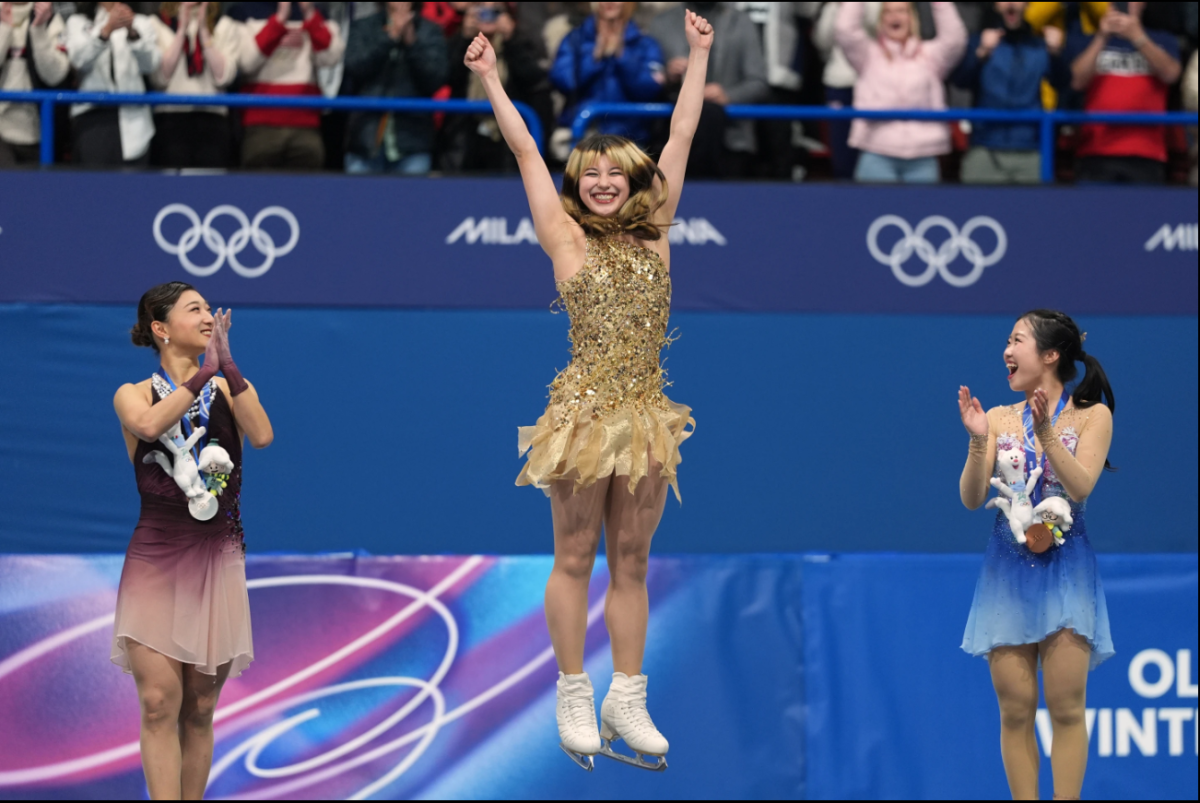
Whether or not you’ve been paying attention to the 2026 Winter Olympics, it’s been almost impossible to go on social media without hearing of the ‘Blade Angels’ – the group nickname for American figure skaters Amber Glenn, Alyssa Liu and Isabeau Levito. Dubbed the ‘Blade Angels’ as a mashup of 2007 figure-skating move ‘Blades of Glory’ and 1970s classic ‘Charlies Angels’, the trio have been making waves at the Olympics and changing the sport as we know it.
Figure skating is not a new sport to the winter Olympics- in fact, it was the first winter sport added to the games in 1908, and has remained a constant in the winter games since 1924. The image of figure skating, however, has not changed in nearly 100 years since its inception at the Olympics. With high costs for equipment and time on the ice, strict gender roles for both individual and group competitions, high physical and emotional demands from strict training and diet regimens, and a lack of diversity within the sport itself, figure skating has long been defined as a sport for straight, white, upper-class men.
The reason the ‘Blade Angels’ are so captivating for audiences is because they’re defying expectations of what figure skaters are on the largest stage in the world.
20-year-old and first-generation Chinese-American Alyssa Liu has broken barriers for her emphasis on mental health and well-being whilst still competing in her sport at the highest possible level. After debuting at the Beijing Olympics in 2022 at the age of 16, Liu quit the sport due to burnout. She returned in 2024, saying that “Skating gave me something to be strong for”, but her comeback was on her own terms – she picks her own music, helps design her own costumes, and knows her own limits. From her alternative style to her brown-and-blonde striped hair, Liu is an inspiration to athletes who don’t fit the ‘traditional’ mold of what their sport requires of them.
As for Amber Glenn, the openly bisexual and pansexual skater is the first queer woman to skate in individual competitions for the United States and is paving the way for a new generation of LGBTQ+ athletes. Despite facing backlash and harassment after initially coming out in 2019, Glenn has used her platform to amplify the voices of her community and support LGBTQ+ athletes. The three-time national champion made history this year after winning gold at the Olympics and continues to shift public perception of the sport and inspire other young queer athletes, from her skating routine to Madonnas’ ‘Like a Prayer’ and the pride-flag pin that she wore as she accepted her medal.
As for Isabeau Levito, the 18-year-olds story is one of homecoming (her grandmother grew up only 13 miles from where the games are taking place in Milan, Italy) and of return in all its forms. After a foot injury that forced her out of skating in 2024 and 2025, Isabeau came back to the ice just in time for the Olympic games. According to Levito, the injury made her “even more grateful for every opportunity [she] get[s]”, and serves as inspiration for athletes suffering from setbacks, proving that you can still achieve your goals despite injury.
Regardless of their social-media virality, Blade Angels are more than just a group of Gen-Z figure skaters who’ve become popular online– they’re a group of three resilient women breaking the historic barriers of figure skating. In a world trying to tell figure skaters what they can and cannot be, the Blade Angels are ushering in a new generation of confident, successful athletes who will not compromise on their individuality. Currently sitting as a group with two gold medals, the Blade Angels have defined the winter Olympics while redefining what it means to be a figure skater.
![Junior Caden Smith has been wrestling since he was in sixth grade and is now a two-time state champion in the 106 lb. weight class. “Caden Smith pinned all his opponents… [Smith] had a lot of pressure on him and he came through in a beautiful way,” said Hazard. Photo courtesy of Caden Smith.](https://valor-dictus.com/wp-content/uploads/2023/03/B3B2C165-AF3F-47B1-9B5D-455B70FDE68D.jpg)